

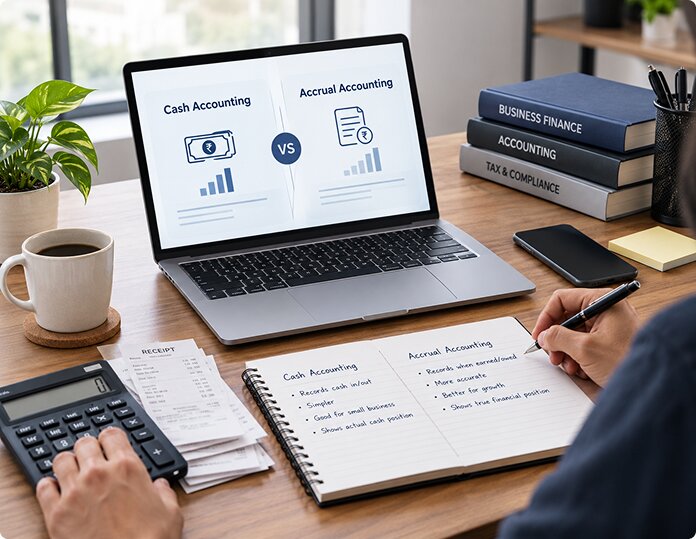
When you begin to learn bookkeeping, two terms are mentioned quite often: cash accounting and accrual accounting.
It may at first appear more complicated than it really is. Both are methods for recognizing when a business recognizes its revenues and expenses. The key difference is what causes the entry: the movement of money or the business transaction.
It is important to understand this difference because the same business transaction may appear in different periods depending on the accounting method that is being used.
Easy way to remember!
Cash accounting – follows the money.
Accrual accounting – follows the transaction.
What Is Cash Basis Accounting?
Cash accounting is where income is generally recognized when money is received by the business and expenses are recognized when money is paid by the business.
Say, for example, a business does a $1,000 job for a customer in December, but the customer doesn’t pay until January. Cash basis of accounting:
- The work will be finished in December.
- The invoice may be issued in December.
- The $1,000 is recognized as income when the payment is received in January.
- The income is recognized upon receipt of cash.
Understanding how transactions move from daily business activities into organised records is also explained in our guide on How Business Transactions Become Records.
What Is Accrual Basis Accounting?
With accrual accounting, income is usually recorded when earned, rather than when the customer pays. In layman’s terms, expenses are usually recorded when incurred, not when paid.
With the same example:
A business completes a $1,000 job in December and invoices the customer. The customer pays in January. In accrual accounting, the $1,000 is typically recognized as income in December because that is when the income was earned.
The amount due is paid with the next payment in January. This means the business records the business activity first and the cash movement later.
This approach requires businesses to understand the difference between recording a transaction and recording the movement of money. Learn more about the basics of maintaining business records in our guide on Bookkeeping for Business Owners.
Cash vs Accrual Accounting: A Simple Example
This is where the difference becomes easier to understand. Imagine a business completes work worth $2,000 on 20 December. The customer pays on 10 January.
Under cash accounting
The $2,000 is recorded when the business receives the payment in January.
Under accrual accounting
The $2,000 is generally recorded as income when it is earned in December, with the later payment recorded when the customer pays.
The business has not changed, nor has the work. Only the method used to record the transaction has changed.
What About Expenses?
The same idea applies to business expenses. Suppose a business receives a supplier invoice for $500 in December, but pays the supplier in January.
With cash accounting, the expense is generally recorded when the $500 is paid.
With accrual accounting, the expense is generally recorded when the business incurs the expense, subject to the applicable accounting rules.
So the two methods can place the same income or expense into different accounting periods.
Is Cash Accounting Easier?
Cash accounting can be simpler to understand because the bookkeeping follows actual receipts and payments. For example:
Customer pays – record income
Business pays supplier – record expense
The IRS notes that many individuals and many small businesses without inventory use the cash method because they find the records easier to maintain. However, whether a business can use the cash method depends on the applicable rules. Businesses should not choose an accounting method based only on simplicity.
Regardless of the method used, keeping accurate records is an important part of bookkeeping. Recording income, expenses, and supporting documents correctly helps businesses maintain reliable financial information. You can also learn more about tracking these activities in How to Track Business Income and Expenses: A Practical Guide.
Why Is Accrual Accounting Different?
Accrual accounting requires the business to keep track of transactions that may not have resulted in a cash movement yet.
For example:
- A customer owes the business money.
- The business owes a supplier money.
- A service has been provided, but payment has not arrived.
- An expense has been incurred but has not yet been paid.
This means the records need to show more than the money currently sitting in the bank. Accrual accounting can therefore provide a record of business activity that is not tied only to when cash changes hands.
This is why understanding the transaction itself is important before recording it. The purpose of bookkeeping is not only to record money movement but also to explain what happened in the business.
Cash Accounting vs Accrual Accounting for Small Businesses
There is no single method that every business should use. A business needs to consider its activities, size, reporting requirements, inventory, applicable accounting standards, and tax rules.
For example, U.S. tax rules allow various accounting methods but also place restrictions on when certain businesses can use the cash method. Inventory can also affect the accounting method requirements. Businesses operating outside the U.S. may be subject to different rules.
So the choice of accounting method should be discussed with a qualified accountant or tax professional where necessary.
Why Good Bookkeeping Matters With Either Method
Whichever method is used, the basic bookkeeping work still matters. A business needs to know:
- What transaction took place
- When it took place
- Who was involved
- How much was involved
- Whether money was received or paid
- Whether money is still owed
- What supporting documents belong to the transaction
Good records start with understanding the transaction. Once the transaction is understood, the appropriate accounting treatment can be applied.
This is also why bookkeeping is easier to learn through real business activities rather than by simply memorising accounting terms. Understanding how transactions are recorded is explained further in our guide on How to Record Cash Transactions in a Business.
Final Thoughts
Cash vs. accrual accounting is not really about choosing between two confusing sets of terms. It is about understanding when a business transaction becomes part of the accounting records.
Once you can see the difference between the transaction and the movement of cash, the two methods become much easier to understand.
And that is where practical bookkeeping begins: understand the transaction, record it correctly, and build the business records from there.
If you are building your bookkeeping knowledge, understanding the difference between bookkeeping tasks and accounting processes can also help. Read our guide on Bookkeeping vs Accounting: What’s the Difference?