

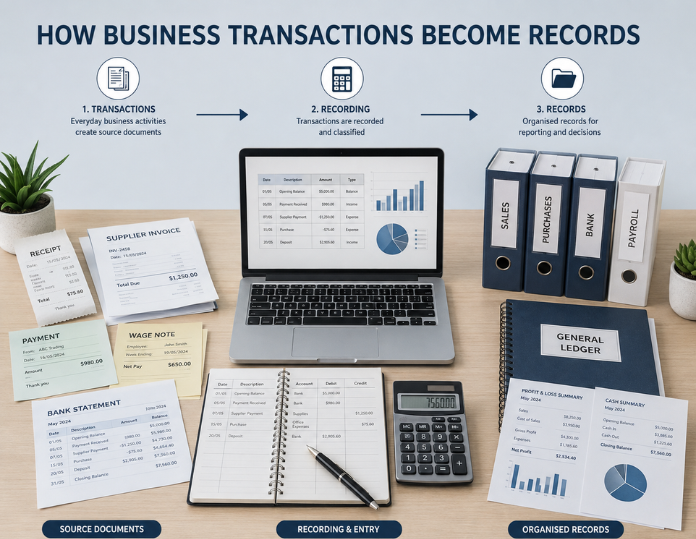
Every business has a story. That story isn’t written in words. It’s written in the everyday transactions that happen throughout the business. A customer buys a product. A supplier sends an invoice. Wages are paid. Stock is purchased. Money is deposited into the bank.
These may seem like ordinary activities, but together they tell you how a business operates. The important question is: How do these everyday transactions become organised business records?
Understanding that bookkeeping process is one of the first steps to proceed further.
Every Business Starts with Transactions
No matter the size of a business, transactions happen every day.
Some are simple. Some are multi-step, but they all share one thing in common: they produce information to be recorded.
Without those transactions being recorded, it is hard to know what has happened, what is still outstanding, or how the business is performing.
A Transaction Is More Than Just a Payment
Most people think a business transaction is just when money changes hands. But, in reality, a transaction is any business activity that changes the records of the business.
For example:
- Selling a product or service
- Receiving payment from a customer
- Purchasing stock or equipment
- Paying wages
- Receiving a supplier invoice
- Paying business expenses
- Depositing money into the business bank account
Each of these activities becomes part of the business’s history.
Recording the Transaction
Once a transaction takes place, it needs to be recorded accurately. This is where bookkeeping begins. The information is entered into the appropriate record, along with important details such as:
- The date
- What happened
- The amount
- Who the transaction involved
- Any supporting documents, such as invoices or receipts
Recording information while it’s fresh helps reduce mistakes and ensures nothing important is forgotten.
Building Business Records
One transaction doesn’t tell you very much. However, hundreds of accurately recorded transactions begin to create organised business records. Think of it like building a puzzle. Each transaction is one piece. On its own, it may not reveal much, but as more pieces are added, the picture becomes clearer.
Over time, those records show:
- Money received
- Money spent
- Outstanding invoices
- Payments made
- Business activities over a period of time
This is how bookkeeping helps organise information into something meaningful.
Why Organisation Matters
Imagine trying to find a supplier invoice from six months ago. Or checking whether a customer has paid an outstanding account. If transactions haven’t been recorded properly, finding that information can become frustrating and time-consuming. Organised business records make it easier to:
- Find information quickly
- Check the accuracy of records
- Follow the history of a transaction
- Prepare information for accountants or advisers
- Meet reporting requirements
Good bookkeeping isn’t about creating more paperwork; it’s about making information easier to use.
From Records to Understanding
Once transactions have been recorded and organised, they begin to answer important questions.
- How much has the business sold this month?
- What expenses have been paid?
- Which customers still owe money?
- Are supplier accounts up to date?
Instead of wading through receipts and paperwork, business owners can simply consult organised records and find the information they require. Here’s where the bookkeeping helps.
It doesn’t just record what happened; it helps you understand what those records are telling you.
Accuracy Makes the Difference
Business records are only as reliable as the quality of the information that goes into them. It’s easy for small errors to confuse: a transaction entered twice, a missing receipt, an amount entered incorrectly.
These small errors can make data difficult to trust over time. Good bookkeeping is why you record transactions accurately and consistently. Good records make everything that follows so much easier.
Learning the Process Through Practice
Many people are introduced to bookkeeping by learning definitions and accounting terms. KYB platform believes there’s a more practical way. Instead of beginning with theory, learning starts with everyday business activities.
You can record a transaction, organise it, and see how it becomes part of the business records. As you repeat the process, you will find that bookkeeping becomes familiar to you.
Why It Matters
Every report, summary, or financial statement begins with one thing: a properly recorded transaction. When those transactions are organised into reliable business records, they provide a clearer understanding of the business.
Whether you’re a student, teacher, entrepreneur, or business owner, learning how business transactions become records gives you a stronger foundation for understanding bookkeeping and the role it plays in every business.
Final Thoughts
Bookkeeping doesn’t begin with complicated reports or accounting terminology. It begins with the everyday activities that happen in every business. Each sale, purchase, payment, and invoice becomes part of the business’s records.
When those transactions are recorded accurately and organised properly, they create information you can rely on. Understanding how business transactions get turned into records isn’t just learning bookkeeping. This is about how businesses record their day-to-day activities and create records that lead to better understanding and better decisions.
Learn Bookkeeping Through Practical Experience
Learning begins with real business transactions. KYB Edu-Kits and KYB CAIR bookkeeping systems help you understand how everyday activities become organised business records through practical, step-by-step learning.