

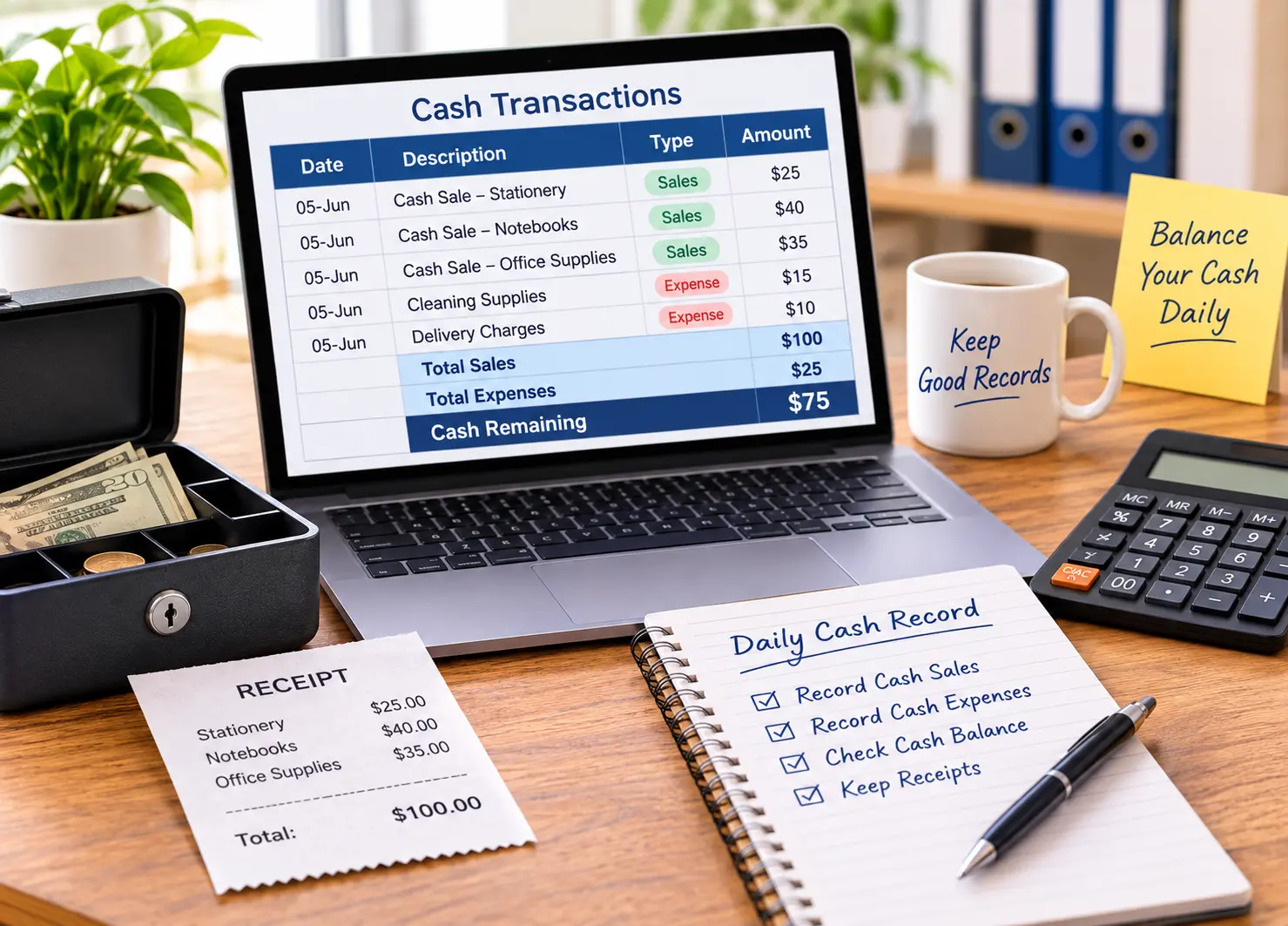
Cash sales and cash expenses are part of everyday business. A shop receives cash from a customer, pays a delivery person, buys cleaning supplies, or makes a small purchase for the business. These may seem like simple transactions, but each one needs to be recorded.
The difficulty is not in recording the amounts. It is making sure that every amount received or paid is accounted for. If cash sales are not recorded, the business records will show less money received than the business actually took in. If cash expenses are missed, the records will not show the full amount spent. Students and business owners can also understand how business transactions become records to see why every transaction needs to be properly documented.
A business owner should be able to see where the cash came from, where it went, and how much should remain. Let’s look at how to record cash sales and cash expenses, step by step.
1. Understand What Needs to Be Recorded
You can do this by separating the two kinds of transactions: cash sales and cash expenses.
• Cash sales are sales in which the customer pays cash at the time of purchase. Suppose, for instance, a customer buys goods for $ 50 and pays cash.
• Cash expenses are cash paid for something the business needs. This might be a delivery fee, office supplies, cleaning supplies, or some other business expense.
The business’s cash will be affected by both transactions. A cash sale increases the amount on hand. A cash expense reduces the amount on hand. The important thing here is to record each transaction in sufficient detail to describe what happened.
2. Record Every Cash Sale When It Happens
Whenever a customer pays cash, enter the sale in the business records. The entry should include:
- Date of sale
- Receipt or transaction number
- Description of goods or services sold
- Amount received
For example, a small shop makes three cash sales during the morning:
| Date | Receipt No. | Description | Cash Received |
|---|---|---|---|
| 5 June | 101 | Stationery | $25 |
| 5 June | 102 | Notebooks | $40 |
| 5 June | 103 | Office supplies | $35 |
| Total | $100 |
These sales have brought $100 to the shop. If the business has a cash register, the total sales per day can be found in the sales records of the cash register. If not, a receipt book or a simple record of daily sales can be used. What counts is that the sales are registered and the total is checked against the cash received.
3. Record Cash Expenses Separately
Cash received from customers is not the same as cash spent by the business. Keep the two records separate so that you can see both amounts.
Suppose the shop pays $15 for cleaning supplies and $10 for local delivery during the same day. The expenses should be entered as follows:
| Date | Description | Cash Paid |
|---|---|---|
| 5 June | Cleaning supplies | $15 |
| 5 June | Local delivery | $10 |
| Total | $25 |
The business has spent $25. Keep the receipt for each purchase. If a receipt is not available, make a note of what was purchased, who was paid, and why the payment was made. A cash payment should not be left unexplained simply because it was a small amount.
4. Keep Cash Sales and Cash Expenses in One Daily Summary
Once the sales and expenses have been recorded separately, you can bring the totals together in a daily cash summary. Using the earlier example:
| Description | Amount |
|---|---|
| Cash sales | $100 |
| Cash expenses | $25 |
| Cash remaining from these transactions | $75 |
This means that after the expenses recorded, $75 remains from the day’s sales. The math is easy:
Cash Sales – Cash Expenses = Cash Left
If the business had some cash on hand at the beginning of the day, you have to factor that starting amount into your calculation of how much cash should be in the register. For example, say the shop opened with $200, sold $100 and incurred $25 in expenses. It should have $275 in it. This is the figure you can compare with the cash in the drawer.
5. Check the Cash at the End of the Day
At the end of the day, count the cash held by the business and compare it with the amount shown in your records.
Using the previous example:
| Cash Details | Amount |
|---|---|
| Opening cash | $200 |
| Cash sales | $100 |
| Cash expenses | $25 |
| Expected cash | $275 |
If you count $275, the cash agrees with the record. If you count $265, there is a difference of $10 that needs checking. Perhaps a payment was not recorded, a sale was missed, or an amount was entered incorrectly. Find the reason rather than changing the figures just to make them agree.
If cash has been taken out of the drawer and deposited into the bank, record that separately as a transfer. It is not another business expense.
6. Keep the Receipts and Other Supporting Records
Every cash sale and cash expense should have some record to support it. For sales, this could be a receipt, cash register record, or daily sales summary. Keep the supplier’s receipt or a cash payment slip for expenses.
If you make small payments from a petty cash fund on a regular basis, keep a separate record for each payment. Write down the date, amount, purpose, and who received the money. These papers help to explain the entries in your books. You can also learn how to track supplier invoices and outstanding payments in Excel to maintain organised records of business purchases and payments.
If you need to check a payment later, you should be able to find the original details rather than relying on memory.
7. Keep Personal Cash Separate from Business Cash
There is one other point worth remembering. The owner may sometimes put personal money into the business or take money out for personal use. These transactions should not be confused with sales or business expenses.
For example, if the owner puts $200 of personal money into the cash drawer, it is not a cash sale. Similarly, if the owner takes $100 out for personal use, it is not an ordinary business expense. Record these amounts separately so that the business records show where the money came from and why it was taken out. For more guidance, read how to separate personal and business finances.
A Simple Daily Cash Record
You can use a simple table to keep track of cash received and paid during the day.
| Date | Description | Cash Received | Cash Paid |
|---|---|---|---|
| 5 June | Opening cash | $200 | – |
| 5 June | Cash sales | $100 | – |
| 5 June | Cleaning supplies | – | $15 |
| 5 June | Local delivery | – | $10 |
| Total | $300 | $25 |
The expected cash at the end of the day is $275. This is a simple starting point for a small business. As the number of transactions increases, you may want separate sales and expense records, with a daily summary bringing the totals together.
Final Thoughts
Recording cash sales and cash expenses should not be left until someone has to work out how much money the business received or spent. A cash sale needs to be entered when it happens. A cash expense needs to be recorded when the payment is made. The supporting receipts and other records should be kept so that every amount can be explained.
When these entries are made regularly, the business owner can see how much cash has come in, how much has gone out, and what should remain. That is what bookkeeping is meant to do. It records the financial actions of the business and shows their effect on the records. Following a monthly bookkeeping checklist for small businesses can help ensure these records are reviewed regularly.