

Teaching bookkeeping should be about more than showing students how to enter figures into journals and ledgers. They need to understand why those entries are made and what they tell us about a business.
A good place to start is with the everyday activities of a business. A business buys goods, sells them, pays expenses, receives money from customers and sometimes has to wait for payment. These are all financial actions, and each one needs to be recorded. Students can also explore how everyday business transactions become financial records to understand how these activities are documented in a business. When students understand what has happened first, learning how to record it becomes much easier.
The following bookkeeping lesson plans give teachers a practical way to introduce the subject. They not only start with simple transactions but gradually move towards keeping business records and understanding the information they hold.
1. Begin with the Activities of a Small Business
Before asking students to prepare journal entries, let them understand what happens in a business. Take a small shop as an example. The owner puts $1,000 into the business, buys goods for $300, sells some goods for $450, and pays $50 for delivery.
Ask students what has happened to the business. It has received money from its owner, purchased goods, made sales and paid an expense. These may look like simple activities, but they are the very things that make up the financial records of a business.
Lesson idea: Give students a list of ten or twelve transactions from a small business. Ask them to read each one and write down what has happened, how much money is involved and whether the business has received or paid money.
Do not rush them into debit and credit entries. First make sure they understand the transaction. There is little point in asking a student to record something they have not understood.
2. Show Students How to Keep a Record of Transactions
Once students know what a business transaction is, show them how to record it. A business cannot depend on memory to keep track of everything it buys, sells or pays for. Each transaction needs a record so that the owner can go back and see what took place.
For a first exercise, students can make use of a simple table with the mention of date, description, money received, and money paid.
For example:
| Date | Description | Money Received | Money Paid |
|---|---|---|---|
| 1 June | Owner puts money into business | $1,000 | |
| 3 June | Purchases goods | $300 | |
| 5 June | Cash sales | $450 | |
| 7 June | Pays delivery charges | $50 |
Now, ask students to have a tab on the entries and describe what they tell them. How much money came into the business? How much was paid out?
Teachers can also introduce practical examples of how to record cash transactions in a business to help students understand how businesses track money received and payments made.
This is, indubitably, a good way to introduce the habit of recording transactions as and when they happen, instead of trying to remember them at the end of the month.
3. Introduce Journals Using Actual Transactions
Students often learn journal entries as rules, with one account on the debit side and another on the credit side. But they should first understand why those accounts are being affected.
Lesson idea: Prepare a set of transaction cards. You can include purchases, sales, and payments to suppliers, money received from customers, and expenses paid by the business. Let students read each card and decide which accounts are affected before making the journal entry.
When studying their work, request them to clarify why they made each entry. Getting the correct answer is essential, but understanding how they reached at it is just as vital.
4. Help Students Understand What a Ledger Shows
A journal records transactions in the order they take place. A ledger brings together the entries relating to each account. This is easier to understand when students have already worked with a few journal entries.
For example, a business may receive cash from several sales and make a number of payments during the month. By looking at the Cash Account in the ledger, students can see all the cash received and paid during that period.
Lesson idea: Give students a finished journal and request them to transfer the entries into the applicable ledger accounts. Use familiar accounts such as Cash, Sales, Purchases, Rent and Suppliers.
When they have finished, ask them what each account tells them. How much cash has come in? How much has gone out? What has been recorded in the Rent Account?
The objective is to help students see that a ledger is not just another exercise to complete. It brings together information that the business may need to check.
5. Teach Students About Purchases Made on Credit
Here is another everyday business activity that students should understand. A business may receive goods from a supplier without paying for them straight away. The supplier allows payment at a later date. The business has received the goods, but it still owes the supplier.
Suppose a shop buying goods worth $400 from ABC Supplies and settles to pay within 30 days. Ask students a simple question: Has the business received the goods? Yes. Has it paid the supplier? No. Does it still owe $400? Yes. This is the sort of situation that needs to be properly recorded.
Lesson idea: Give students three supplier invoices and ask them to record the invoice amount, any payment made and the amount still owed. Ask students which supplier has been paid in full and which amounts are still outstanding.
This exercise helps them understand that receiving goods and paying for them are two different financial actions. Both need to be reflected in the business records.
A practical extension of this activity is learning how to track supplier invoices and outstanding payments in Excel, which shows how businesses monitor amounts owed to suppliers.
A Simple Bookkeeping Lesson Plan for Teachers
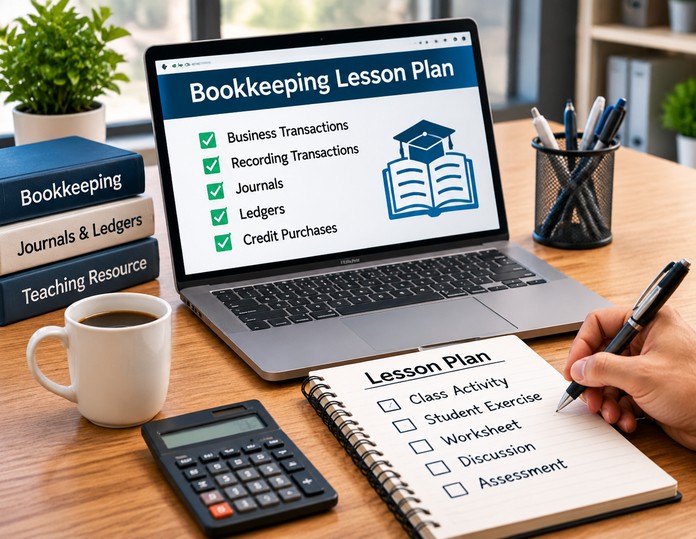
Teachers can arrange these activities over a series of lessons, allowing students enough time to understand each part before moving on.
| Lesson | Subject | Classroom Work |
|---|---|---|
| 1 | Business transactions | Identify everyday business activities |
| 2 | Recording transactions | Prepare a simple record of money received and paid |
| 3 | Journals | Record transactions in journal format |
| 4 | Ledgers | Transfer entries into ledger accounts |
| 5 | Credit purchases | Record supplier invoices and payments |
| 6 | Business exercise | Keep records for a small business |
| 7 | Understanding records | Use the records to answer questions about the business |
There is no need to show imperativeness through the lessons. If students are having trouble understanding a transaction, it is wise to spend more time on it before moving to the next subject.
Final Thoughts
Bookkeeping is best assumed when students can pick up what happens in a business and how those actions are logged. Learning the rules of journals and ledgers has its place, but those rules make more logic when students understand the transactions behind them. Teachers should give students chances to record business activities, to trace entries through the records, and to discover what information the records tell them.
The reason to learn bookkeeping does not just know about how to make entries. Instead, it is to recognize the money side of a business and have records to show what actually has happened.