

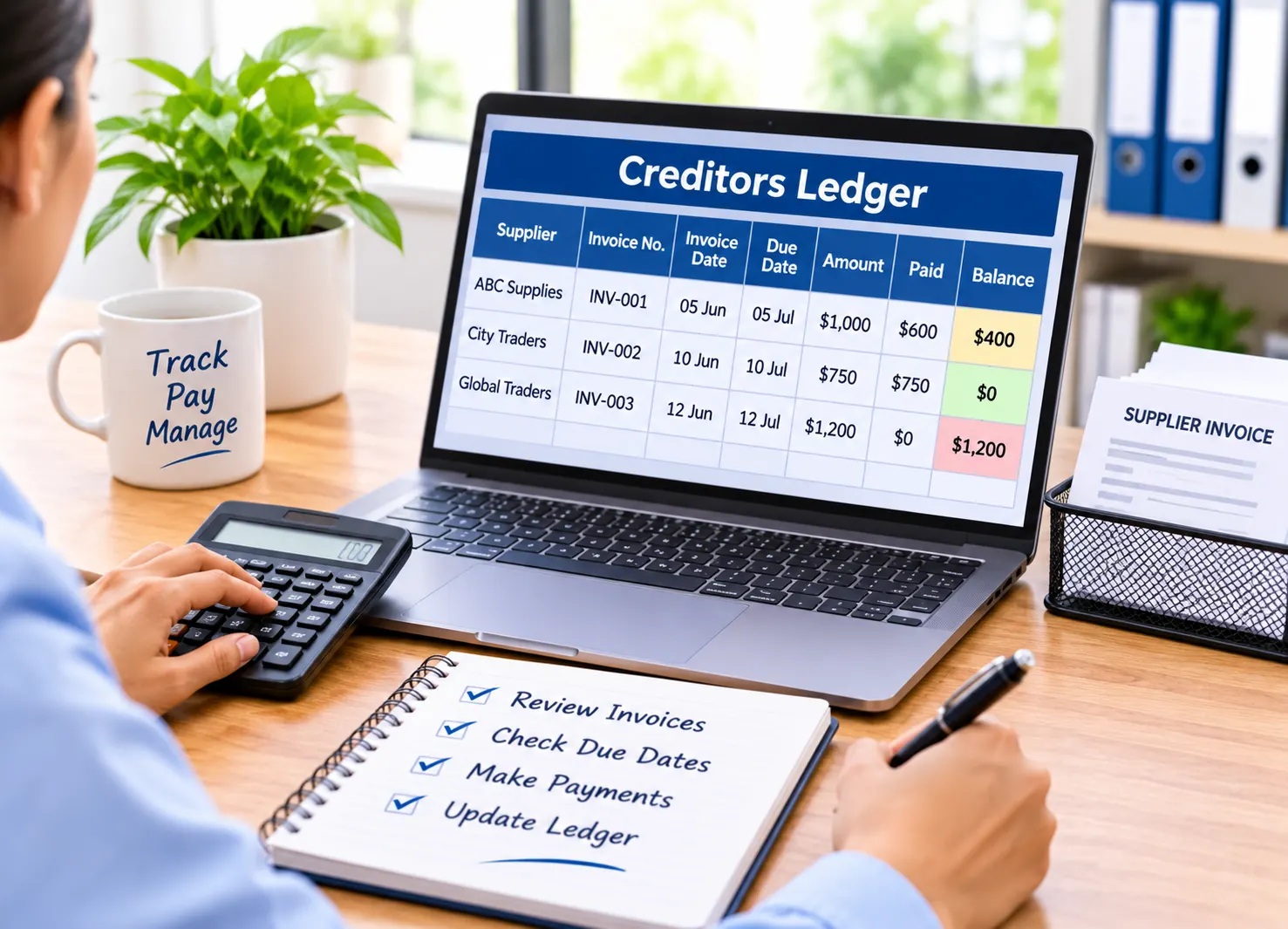
When you buy goods from a supplier and agree to pay later, you owe that supplier money. It is as simple as that. But what happens when you buy from five or ten different suppliers? How do you know what you owe each one? Have you paid the last invoice? Is there still an amount outstanding from the previous month? When is the next payment due? You cannot rely on memory to answer these questions. You need proper records. A creditors ledger is all you need to maintain to keep track of the money your business owes to its suppliers. It shows what you have purchased on credit, what you have paid, and what is still outstanding.
Let’s look at how it works and why every business that buys on credit should keep one.
What Is a Creditors Ledger?
A creditors ledger is a record of the expenses your business has a loan from individual suppliers. At the time of purchasing goods or services on credit, an invoice has been sent to you by the supplier. This confirms that you have received goods or services from the supplier but have not yet paid for them. The amount becomes payable to that supplier.
You record the invoice in the supplier’s account in the creditors ledger. When you make a payment, you record that too. The balance then shows how much you still owe.
For example, suppose you buy raw materials from ABC Supplies for $1,000 and agree to pay within 30 days. The $1,000 is entered in ABC Supplies’ account. If you pay $600 a week later, the remaining amount is $400. That is what the creditors ledger is there to show.
Each supplier has a separate account, so you can check what you owe without mixing one supplier’s transactions with another’s. You may also hear it called a purchases ledger or accounts payable ledger.
How Does a Creditors Ledger Work?
The best way to understand it is to follow an actual purchase.
Suppose ABC Supplies is where your business goes to buy packaging material. You were billed by the supplier in the amount of $1,000 on June 5. Then you pay $600 on June 15.
Here, the account for ABC Supplies will show:
| Date | Details | Amount |
|---|---|---|
| 5 June | Goods purchased on credit | $1,000 |
| 15 June | Payment made to supplier | $600 |
| Amount still owed | $400 |
The business still owes ABC Supplies $400. Keep in mind that receiving the goods and paying for them are two different transactions. The purchase is recorded when the business takes delivery of the goods and becomes liable to pay. And the payment is recorded when money is actually paid to the supplier.
This distinction is also important when understanding different accounting methods. Read our guide on cash vs accrual accounting to learn how businesses record income and expenses based on when money changes hands or when transactions occur.
If you only record the purchase and forget to record the payment, your books will show that you owe more than you really do. The same applies if you return goods or receive a credit note from the supplier. That adjustment must also be recorded.
What Should You Record in a Creditors Ledger?
Keep enough information to understand every amount owed. You should not have to search through old paperwork every time you want to know why a supplier is asking for payment. For each supplier, you need to record:
- Supplier’s name
- Invoice number
- Invoice date
- Payment due date
- Amount of the invoice
- Payments made
- Returns or credit notes
- Balance still outstanding
You can maintain these details in a spreadsheet or bookkeeping software. The method is not as important as keeping the information accurate and up to date. If you receive an invoice, record it. When you make a payment, enter it against that supplier’s account. Do not leave it until the end of the month and try to remember what happened.
If you manage supplier records using spreadsheets, our guide on how to track supplier invoices in Excel explains how to organise invoice details and monitor payments in one place.
Why Does Your Business Need a Creditors Ledger?
A business needs to know what it owes, just as it needs to know what money it has received. If you buy on credit and do not keep proper records, you can easily lose track of your payments. Here are some reasons to maintain a creditors ledger.
1. Know What You Owe Each Supplier
Suppose you buy materials from ABC Supplies, office items from City Traders, and equipment from another supplier. If you keep only a note of the total amount owed, you will not know how much belongs to each supplier.
A creditors ledger gives you a separate record for each one. The account can be checked by you to see the invoices, payments, and remaining balance.
2. Pay Suppliers on Time
Every supplier may have different payment terms. One may ask for payment within 15 days, while another may allow 30 days. If you do not record the due dates, it is easy to miss a payment. Keeping the due date with the invoice helps you see what needs to be paid and when.
3. Avoid Paying the Same Invoice Twice
The chances of this happening are possible only if records are not kept properly. You could receive an invoice again or someone could forget a payment has been made already.
Check the creditors ledger before paying the supplier. It should indicate if the invoice is unpaid, partially paid, or fully paid.
4. Check Supplier Statements
It has been found that suppliers time and again send statements showing the invoices they have raised and the payments they have received. So, compare the statement with your own records. If the balances are different, find out why.
Perhaps you have not recorded a payment. Maybe an invoice is missing, or a credit note has not been entered. Do not simply accept the supplier’s balance without checking it. Your own records should tell you what has happened.
5. Know How Much Money You Need for Payments
A business may have money in its bank account today, but that does not mean all of it is available to spend.
Some of that money may be required to pay suppliers. The creditors ledger is where you can see what payments are still outstanding and how much money you need to have available. This helps to plan purchases and other business expenses.
Keeping supplier accounts updated should be part of your regular bookkeeping routine. Our monthly bookkeeping checklist for small businesses covers important record-keeping tasks that help businesses maintain accurate financial records.
What is the difference between Debtors Ledger and Creditors Ledger?
Both records deal with transactions on credit, but they are the opposite sides of the business.
| Creditors Ledger | Debtors Ledger |
|---|---|
| Shows money your business owes suppliers. | Shows money customers owe your business. |
| Records credit purchases. | Records credit sales. |
| Helps you track supplier payments. | Helps you track customer payments. |
| Shows amounts payable. | Shows amounts receivable. |
The creditors ledger tells you who your business needs to pay. The debtors ledger tells you who needs to pay your business.
Managing customer payments is equally important for maintaining healthy cash flow. Our guide on tracking overdue invoices and customer payments explains how businesses can monitor outstanding customer balances and follow up on unpaid invoices.
Final Thoughts
If your business buys goods or services on credit, you need to know exactly what you owe and to whom. Do not wait for a supplier to send a reminder before checking an outstanding invoice. Do not depend on memory to work out whether a payment has been made. Keep a record of every invoice, payment and adjustment.
A creditors ledger gives you that record. This helps figure out what you owe your suppliers, plan payments and spot any mistakes before they become bigger problems.
The important thing is not only to record what you have purchased. You also need to keep track of what you’ve paid and what you still owe.